
He Left His W-2 to Go All In on Local Media
Sam Harper grew The Waco Buzz to 16,000 readers, waited until it beat his salary for months, then went full-time. Here's how he spends the week now, and why he rented Baylor's football stadium.
 TJ LarkinHost, Local Media HQ PodcastSeptember 14, 2026 · 7 min read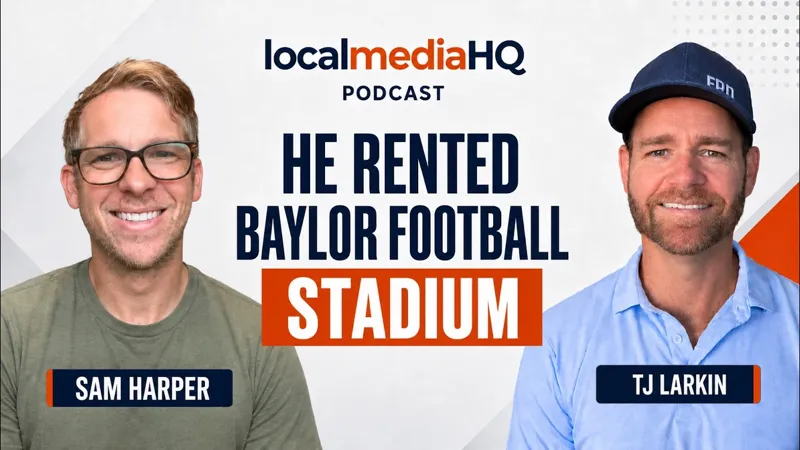
- He waited for proof. The Waco Buzz first out-earned Sam's W-2 in December. He kept that up for a few more months, saved runway, then went full-time in June.
- Full-time means relationships. "You're not going faster than your ability to build relationship." His week is coffee, meals and new partners.
- Events made it a brand. A monthly Dinner Club, talks with local professors, and now Waco's first paper airplane championship inside Baylor's football stadium.
- Meta grows the list. LinkedIn books the meetings. Posting four to five times a week put him in front of university VPs and company presidents.
Sam Harper runs The Waco Buzz, a local newsletter that reaches 16,000 people in Waco, Texas. Three months before we recorded, he left his corporate job to run it full-time. In this conversation he walks through exactly how he decided it was time, what a full-time week looks like when the job is "local media," and the event he's most excited about: a paper airplane championship inside Baylor's football stadium.
How he knew it was time to quit
For most of its life, The Waco Buzz lived in the margins. Sam was writing early in the morning and late at night, around a corporate job, three kids and everything else. As it kept growing, he realized it had become more than a fun side project, and he had to decide what to do with it.
The test he and his wife set was simple. In December, for the first time, the newsletter made more money than his W-2 paycheck. Their rule: if it could do that for a handful of months in a row, it wasn't a fluke. It did. Sam also built up a few months of runway, so the worst case was trying, failing and finding another job. In June he went all in.
What a full-time week actually looks like
The surprise of going full-time wasn't more writing. It was relationships. Sam calls Waco "the biggest small town in the country," a place that runs on who you know. In his words, "you're not going faster than your ability to build relationship."
So his week is a lot of coffee and a lot of meals. Priority number one is new partner development: finding the people and businesses he can work with, and showing up where he can meet them. It's the one part of the job he says he would never outsource. He describes himself as a bridge builder for people across the city, and he says that's the most rewarding part of the whole thing, outside of providing for his family.
Events turned a newsletter into a brand
Sam launched a monthly Dinner Club, which matches local strangers for dinner. It's about to hit one year. After the very first one, he noticed people started seeing The Waco Buzz as a brand, not just an email. Local TV covered it a couple of months in.
Then came Social Studies: a local professor from Baylor, McLennan Community College or the technical college gives a talk at an unexpected venue. And then the big one.
I've rented out Baylor's football stadium and we're going to do Waco's first ever paper airplane championship.
It sounds wild, and Sam says it's less crazy than it seems. The stadium usually sits empty, so a Sunday afternoon event that brings people in to buy food and drinks is a win for them. He isn't trying to fill tens of thousands of seats. His goal is 200 to 250 people having a great time for two hours. A local STEAM children's museum will help kids build their planes, which keeps it easy to run.
He pressure-tested the idea before announcing anything by landing a sponsor first, a company from the aerospace industry in the greater Waco area. Between that sponsor and ticket sales, he expects to walk away profitable.
- 01It's fun first
If it isn't fun, nothing else matters.
- 02People do something together
Not just watch. Everyone builds, flies, eats or talks.
- 03It's easy to fulfill
No vendor sprawl, no bloated production. Keep it simple enough to repeat.
"Last mile marketing" is the sponsor pitch
At the home services company where he used to work, they talked about last mile marketing: all the ads in the world don't replace being on the ground with people in your community. Sam uses that exact framing with sponsors now. At the paper airplane championship, people will literally put their hands on a sponsor's logo while they build their planes, and remember it.
Meta grows the list. LinkedIn books the meetings.
Sam grew the newsletter mostly by acquiring subscribers through Meta ads. But plenty of decision makers in Waco aren't on Instagram or Facebook. They're on LinkedIn. So in the last few months he started posting four to five times a week using a social selling playbook from a LinkedIn creator he follows.
Within the first week, VP and president level people from local universities and companies reached out. He also uses LinkedIn to sell open slots directly, with posts like: tomorrow's newsletter goes to 16,000 people in town, and one sponsorship spot is still open.
His other habit is even simpler. Once a week he searches LinkedIn for posts about Waco from national companies, like a new apartment complex or a new Sprouts, and comments to welcome them to town. Those comments have turned into brand partnership conversations. His rule of thumb: comment on 10 people's posts a day.
Good Life in Waco
Inspired by another creator's anonymous salary surveys, Sam built Good Life in Waco. Readers anonymously share where their pay started and where it is now, plus how their relationships and health have changed since moving. The answers go in the newsletter and get reposted on LinkedIn.
The audience Sam is really thinking about is employers. Companies trying to recruit people to Waco want their teams to hear that moving there isn't a step backward. The series feeds his job board, which he's run since January, and an upcoming 30-day "how to start building wealth" campaign with a local wealth management firm.
His advice on social
- Get on video. "People love people." If you're in the community building business, the founder on camera goes a long way.
- Use carousels for evergreen content. They keep working long after they're posted.
- Post natively. Upload to each platform instead of cross-posting. Sam admits this is gut feel, not data.
- Use a personal LinkedIn account, not a brand page.
The big idea to take home
Near the end, Sam shares an idea he picked up from other local media operators: the New York Times is basically a games company that happens to write articles. If the biggest newspaper in the country is really an engagement business, local media can be one too. For Sam, that means dinners, talks and a stadium full of paper airplanes, all paid for by sponsors who want to be part of it.
Questions people ask
Who is Sam Harper?
How did Sam know it was time to quit his job?
How does The Waco Buzz grow?
How can a paper airplane championship at a football stadium be profitable?
TJ is the founder of Local Media HQ. Every week he talks with local media operators about what is actually working in their towns.