
A free roof, 12 videos and 170 leads for a local roofer
Katie Myers built Localish Janesville on Facebook and TikTok, not a newsletter. Here's how a free roof giveaway turned 11 or 12 videos into 170 leads.
 TJ LarkinHost, Local Media HQ PodcastSeptember 3, 2026 · 9 min read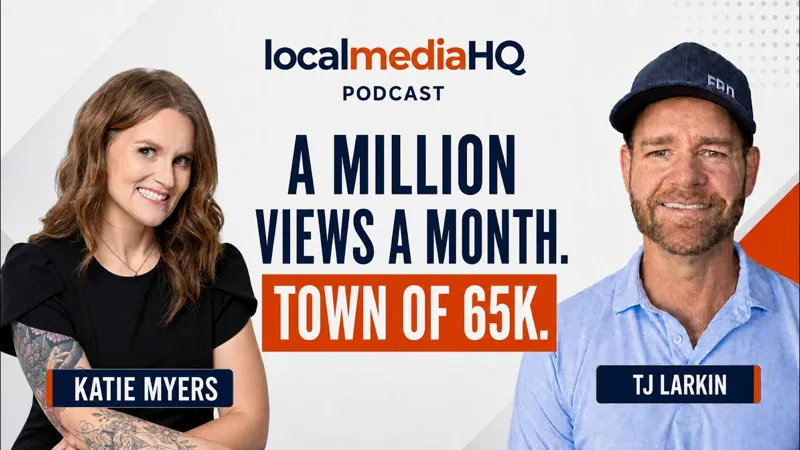
- Social first, newsletter later. Localish Janesville started in February and averages about a million views a month. The newsletter has about 300 subscribers.
- A free roof became a lead machine. Katie partnered with a local roofer on a giveaway. 11 or 12 videos brought in 170 leads, and he's already sold roofs from it.
- She only sells to big spenders. Katie targets businesses spending more than $50,000 a year on advertising, not mom and pop shops paying $250.
- The dinner club worked fast. 50 people came to her first one in June, mostly strangers, with almost no email list behind it.
Katie Myers runs Localish Janesville, a local media brand in a Wisconsin city of about 65,000 people. She isn't a newsletter operator first. She's an insurance agency owner who learned that posting on Facebook built trust faster than any networking event, then noticed her most-watched videos were about the town, not about her. In this conversation she walks through a free roof giveaway that pulled 170 leads, why she only pitches big advertisers, and her plan to put Localish in every city in America.
How Facebook built her insurance agency
Katie started in insurance in 2015 and kept doing what she'd always done: sharing a lot on Facebook. She calls herself an "annoying Facebook mom." It worked. When people opened a high insurance bill, they remembered her.
She opened her own agency in Janesville on March 1, 2020, in a community where she knew one person, and she hired that person. Then the networking events she'd counted on stopped completely. So she leaned harder into posting online, and her customers kept following her. Within the first year or two, she says, she was producing about $60,000 in brand new business.
That content still pays off. In a business where most agents work purchased leads and close less than 10%, Katie says her agency closes 50% of the people who get a quote, because they already know and like her before they call. She borrows a phrase from Rory Vaden for this: digitizing your reputation. "You can only go to so many chamber meetings and BNI meetings."
The numbers that pointed to local
About three years ago, Katie started watching AI change the insurance industry and looked for a way to diversify. She went bigger on content. In 2025 she had 80 million views across platforms.
When she dug into the analytics, she noticed something. About 50 million of those views came from videos about small businesses and things going on around town, just because she was involved in them.
So in December she built an app called Localish on Replit. She calls herself "not a tech person," but three videos about it brought 1,800 downloads in the first month. A developer quoted far more than she could spend to finish it, so she pivoted. Localish is now a website, but mostly it's a social channel on Facebook and TikTok.
Katie says TikTok has "shifted dramatically" for local content in the last few months. She sees it both in Janesville and in Seattle, where her family owns a dog grooming business and she runs the marketing. Instagram is the weak spot, with under a thousand followers, and she's hiring help for it.
A dinner club with almost no email list
Katie heard about dinner clubs on this podcast and planned one the same day. Her first dinner in June drew 50 people. Most were complete strangers, ranging from their 20s to their 60s. She's hosted four this summer.
One test flopped. Friends asked for a business-networking-only dinner, and only about 15 people came. Her takeaway: from now on, it's all social. The next step is a Localish Madison dinner club, 45 minutes away, run with a partner who makes the content and sells the advertising there. When Katie posted about it in a Madison group, one woman commented, "Oh god, now you're here too." Katie took it as a sign she's being noticed.
Why she only sells to big advertisers
Katie has a successful business outside Localish, and she's clear that driving to a shop to make a $100 video is a bad use of her time. So she targets only companies spending more than $50,000 a year on advertising.
She's careful to say she loves small business. But most small owners don't understand marketing and run thin margins, and she isn't going to fight to "get 250 bucks out of them." The better targets are the bigger small businesses, like contractors, that already spend on billboards and commercials. Her case to them: people spend at least two hours a day on social media, and it takes 8 to 12 touches to convert someone. "They're going to drive by your billboard twice."
The free roof that pulled 170 leads
After hearing TJ's earlier interview with Cole, a former roofer who gave away a roof on video, Katie took a roofer she wanted to know better out to breakfast. He was spending a lot on advertising, and he told her he'd always wanted to give away a free roof. She said she knew how.
The timing helped. Janesville had a catastrophic flood in April, the area became a FEMA disaster area, and Katie calls the hail damage the worst of her insurance career. Lots of people needed roofs.
- 01Tease it
A video right after the breakfast: they're giving away a free roof, details next week.
- 02Announce it
An official video, plus a Google form open for about a week and a half.
- 03Ask for stories
The form asked why each person should be chosen, and said Rooster Roofing would contact them for a quote.
- 04Let the roofer own it
The contest, the choice and the liability were his. Katie was the marketing partner.
- 05Film the call
They called the winner together on camera, then planned a wrap-up video.
Katie privately hoped for 50 sign-ups. With 11 or 12 videos, they got 170 leads. Roofers pay anywhere from $40 to $300 per lead. Not everyone is a perfect customer, she says, but she read the names and saw a lot of good ones. Some entrants even wrote that they wanted a quote whether they won or not.
The winner was a veteran who served seven tours in Iraq and was going through back surgery. When they called to tell her, she cried. By the morning Katie and TJ recorded, the roofer had already sold a few roofs from the leads, and Katie plans to use those results to sell more advertising packages.
Her reason for building it this way: she wants a lead system for local businesses, the way Zillow works for real estate. "Exposure is great, but exposure doesn't pay my bills."
The polished video flopped
The best performers were the two announcement videos and the call to the winner. Katie also hired a professional drone operator, who made a beautiful video with the company's logos everywhere. It did the worst of all of them.
He did a phenomenal job. I do not do a phenomenal job. And that's why my content takes off.
What did work: silly videos dancing with Rooster Roofing's rooster mascot, and a mashup of friends' reactions. Katie asked on her personal Facebook for volunteers to film themselves talking about the giveaway however they wanted. One husband spit water in his wife's face. Another man comforted his roof. People shared it because their friends were in it.
Her advice on content
- More is more. Big creators publish hundreds of pieces a day. Three polished videos a week won't give you the feedback loop you need.
- Don't stay in one lane. Her early TikToks about sales went nowhere. Some of her best performers were things she never expected to pop off.
- Let business owners film. When Katie couldn't make it to a boutique's back to school event, the owner filmed her own video and Katie posted it.
- Watch for new formats. A "who's hiring" poll on her personal Facebook got about 75 comments in under 24 hours. She's thinking about a weekly sponsored jobs series.
The big vision
Katie doesn't want to be the face of Localish. She's driven a car with her face on it for six years for her agency. She wants the brand to take on a life of its own, in every city in America, with local partners who stay inside the brand guidelines but cover what they care about. Her Madison partner has younger kids in sports, a world Katie says she knows nothing about.
She'd like to try Localish West Seattle next, possibly into 2027 once her systems and people are in place. Her long-term goal is to build a company worth acquiring and give away $100 million. And if you want to bring Localish to your city, she says, reach out.
Questions people ask
Who is Katie Myers?
How did a free roof giveaway get 170 leads?
Why doesn't Localish lead with a newsletter?
Which advertisers does Localish go after?
TJ is the founder of Local Media HQ. Every week he talks with local media operators about what is actually working in their towns.