
Start With a Local SEO Service, Then Add Media and Directories
Tim Stoddart explains why he tells people to start a local newsletter and a local SEO agency, how to build a local directory, and why local search is the safest place to be as AI spreads.
 TJ LarkinHost, Local Media HQ PodcastAugust 29, 2025 · 9 min read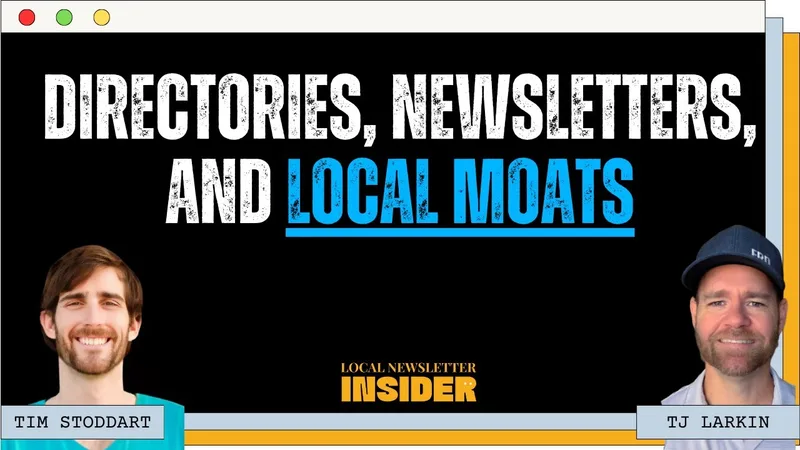
- Stop trying to look polished. Tim's growth opened up once he stopped taking his personal brand so seriously, starting with featured images of his own head blown up like a bobblehead.
- Start with a service, then add assets. His highest-probability path: a local SEO service for cash, a local newsletter for authority, then directories that you can build with the money.
- SEO is simple, not easy. You do the work and take the money today, knowing results may be weeks or months away. Tim says the part people actually screw up is sales.
- Local is the safer bet with AI. Google already owns the local business listings, so Tim doesn't expect AI answers to replace them. He is more excited about local than he has ever been.
Tim Stoddart has built media sites, an agency and a string of directories, and he has strong opinions about the order to do it in. Our conversation starts with why he quit overthinking his content, then gets practical: what to sell, who to sell it to, how to build a directory, and why he thinks local survives AI better than almost anything else.
He stopped taking it so seriously
Tim's first brand was about sobriety, and it worked because he was just sharing his story. Later he got smart about technical SEO and tried to optimize every article perfectly. It stopped being fun. He asked himself what the point was if he got nothing out of it except a bigger reputation.
So he started making his featured images silly: his own head blown up like a bobblehead doll. It was so ridiculous that he stopped taking everything so seriously. He decided "this is me, I don't know how else to be," and everything opened up.
I told him that's exactly what makes his videos work. He films in his bedroom or whatever room he's in, with no fancy editing. Tim's take is that the people chasing short-form junk food videos aren't who he's going after anyway. He does put effort into the substance of what he says, and the people who follow him are the ones who might actually buy.
From a sobriety blog to Quantum Leads
Tim got sober at 24 and started documenting it. He became a professional in both marketing and media in that space, built an agency that specialized in it, and sold his stake the year before we recorded. Along the way his team built media sites, lead-generation directories, and he bought Copyblogger.
After the sale he walked around the lake near his Colorado home for two months and asked what to do next. He realized the people who influenced him most were all writers. So he started a daily newsletter, started recording YouTube videos about how he builds companies, and kept a smaller agency, Quantum Leads. He now uses those agency services for cash, equity and partnerships. He no longer wants 40 employees and a pile of partners.
Start with a service, then add media
Tim thinks in probabilities. To him the highest-probability path is a service business, then a local internet service, then a local SEO company. You use the cash to buy other assets, and an asset doesn't have to produce revenue to have value.
Newsletters, agencies and lead-generation sites work well together. A local newsletter makes you an authority in your town, and that lets you build relationships with the business owners. Local brick-and-mortar businesses are his biggest opportunity right now. They are busy running the business and they all need more customers.
For me, the angle is that a newsletter shouldn't just sell ads. If you have a second business that benefits from your audience, you earn far more per lead. Tim agrees, and his advice to anyone who asks where to start never changes: get a local newsletter going, build a local SEO agency, land your first client, and don't think about anything else until you have.
Why the local pack matters
Tim says to watch your own behavior. You search "coffee shop near me" or "appliance fixer near me," always on your phone, and you get the local pack: the map with three listings. Almost nobody taps "see more," so ranking in the top three is close to winner take almost everything.
Ten clients at 1,500 to 2,500 a month is where he says you get real money to invest. Tim says agencies get knocked for thin profit margins, but they have great cash flow. From there you can live a simple life, put money into local newsletter ads, or build directories, which is where he went next.
One offer for businesses that can pay
We talked about bundling a newsletter ad, a directory listing, SEO, a podcast spot and an Instagram post into one price. Tim doesn't object to packages. But for someone just starting, he'd pick one offer, because a package means more moving parts to sell and more to deliver. If you already have a service, you can sell a bigger package or cross-sell after you close the first deal.
He suggests aiming for 2,000 a month. That means going after businesses that can afford it, which rules out the low-hanging fruit most new agencies chase, and Tim calls that a race to the bottom. His examples are roofers, dentists, dental implants, and health clinics: hormone, testosterone and fertility.
I find that people are scared to sell. That's a lot more what holds people back than the actual technical aspect of it.
SEO is simple, not easy, and sales is the hard part
I told Tim SEO sounds intimidating when you've never done it. His answer: it's simple, not easy, like most things worth doing. People who are good at it handle delayed gratification. You do the work and take people's money today knowing they won't see results for a couple of weeks, maybe a couple of months.
He compares it to fitness. You show up every day and don't watch the results, which he says is ironically the best way to get them. Master three things plus repetition and process, he says, and you'll be great at it. What trips people up is sales. They're afraid to ask for money, and Tim credits his willingness to do exactly that for his repeated success.
How Tim fell into directories
Tim's directory story starts in South Florida, where he was getting sober and living on his cousin's couch. A friend sold ads for a magazine aimed at country clubs and found the clubs through a directory that was worth a couple million dollars. They figured plenty of people were looking for rehabs the way that call center was looking for country clubs.
Meanwhile Tim kept blogging, and people were reading it. They combined the blog and a directory into a media site around recovery. Treatment centers from across the country started calling to ask how he built it and whether they could advertise. He had been reading Copyblogger, whose philosophy is that you build a brand and an email list rather than sell ads.
From there he built directories on moving, stem cells (he shut that one down after botching the site structure and is rebuilding it) and plant medicine retreats. He mentions a friend who built a directory of portable toilets by following music festivals. His take: there are infinite little communities, so directories have infinite possibilities.
Three kinds of directories
I asked Tim how a local media operator should think about a directory with every category but only one location, especially with Yelp and Google already out there. He breaks it into three types:
- Industry focused. One industry across many locations, like Sober Nation, which ranks for drug rehab in as many places as possible.
- Location focused. One location, many industries, like a Denver business directory with electricians, contractors and hair salons.
- Both. Many industries and many locations. Tim calls these nightmares. His plant retreats directory has that problem, with several retreat types across several countries.
Industry and location directories are the same thing in reverse, only the categories change. For a local directory, you go one category at a time, with multiple listings plus an intro of around 200 words on each category page. Tim says that paired with a local newsletter it's close to unfailable, as long as you push through the discomfort of selling.
Why local search holds up against AI
Tim has made a few YouTube videos on this because everyone is scared of AI. Search for something locally and you don't see a Gemini answer. Google already owns the business listings, and a text snippet wouldn't show you the business better than the listing does. He admits nothing stays the same forever, but right now he's more excited about local than ever.
I added my own view: AI will make people trust less of what they see online, so they'll trust what they can see in person. Tim agreed and gave his own examples. His Muay Thai gym has gotten far more popular, his wife runs breath work events, and the farmers market down the street has never been busier. The more digital things get, he says, the more people go back to humanity.
What Tim told people to do
- Start with one service. Local SEO, one offer, around 2,000 a month.
- Aim at businesses that can pay. Roofers, dentists and clinics, not the cheapest leads.
- Add a local newsletter for authority. It gets you in front of the business owners.
- Build directories later, one category at a time, once the service is paying for it.
Questions people ask
What did Tim Stoddart build?
Why does Tim recommend a local newsletter and a local SEO agency?
What are the three types of directories?
Why doesn't Tim expect AI to hurt local search?
TJ is the founder of Local Media HQ. Every week he talks with local media operators about what is actually working in their towns.