
Why "ugly" ads work in a 20,000-person market
Tance Hughes runs The Miss Lou Brew across Vidalia, Louisiana and Natchez, Mississippi. He explains why cheap-looking video ads win, why he sends two to three times a week, and how a newsletter feeds his coffee shop.
 TJ LarkinHost, Local Media HQ PodcastOctober 10, 2025 · 8 min read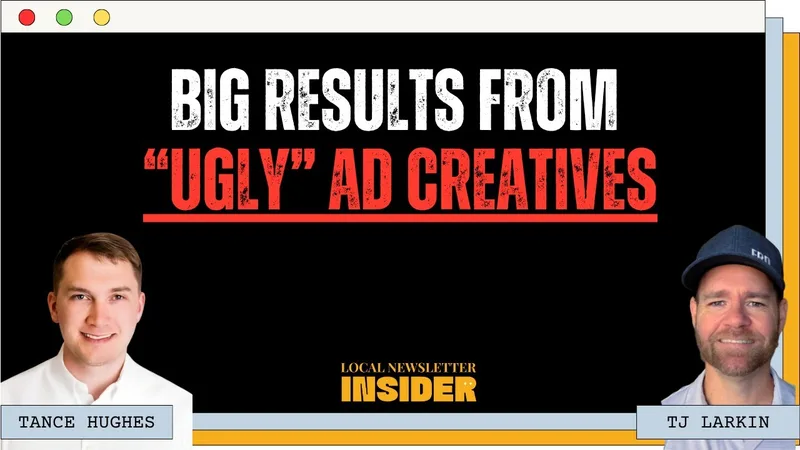
- Ugly ads work. Tance says video with text on top is a strong Meta format across almost every industry, and he uses it for his own local newsletter. Skip the photo shoot and test something rough.
- In a tiny market, frequency is the thing to watch. Meta costs are no different than anywhere else, but you can burn out a small audience fast, so you keep putting up fresh creative.
- Send more often, keep it short. Tance went from one send a week to two or three, and each issue takes two to three minutes to read. Shorter issues tend to get more engagement.
- Use the newsletter to sell your own businesses. His coffee shop is the title sponsor, and he says the coffee shop has seen more business and strong results on limited time offers since he got more consistent.
Tance Hughes publishes The Miss Lou Brew for Vidalia, Louisiana and Natchez, Mississippi, two river towns with about 20,000 people between them. He started it to market his own coffee shop and self-storage business without paying Meta every time. In this conversation he covers what a very small market gives you and takes away, why ugly ads beat polished ones, and why short, frequent sends suit a town where there isn't that much news.
A closed business pushed him into newsletters
Tance ran a company in his hometown for 15 years. A few years ago it closed, and he had to pivot completely. He opened a coffee shop, got deep into email marketing and newsletters, and now works full time in digital marketing.
Day to day he is marketing director at GrowLetter, an agency that helps media companies grow their subscriber counts. He says he sees the work across a lot of industries. A few of the agency's clients are in local newsletters, but most are not, and the local ones tend to be statewide or big-metro publications that can afford an agency.
One market that straddles a state line
Vidalia has about 4,000 people. Natchez, right across the Mississippi River, has about 15,000. Tance calls it roughly 20,000 people and says it feels like one community, with the area acting as the hub for the next 50 to 60 miles.
He started The Miss Lou Brew just over a year ago. The goal was to have a dedicated outlet to advertise his coffee shop and his self-storage facility on a consistent basis, and to get out updates whenever he needed to.
The downsides are real, but so is the blanket coverage
Tance is upfront about the downsides. The total market is small, so the newsletter will never get huge. It is also not a strong economic area, so there aren't many large advertisers with big sponsorship budgets, and a small list won't command much anyway.
The upside is that you can become a big fish in a small pond very quickly. You become a trusted voice, and he says that gets you a lot of blanket coverage fast, which he has. TJ adds that with so little competition, people tend to like you more because you're one of the only ones doing it.
Meta is the only way he has grown, and frequency is the catch
Meta is the only acquisition Tance has run. He built a waiting list at the start and then scaled it up with small amounts of money.
TJ asked whether a tiny area costs more. Tance said no: costs and CPMs are no different than anywhere else. What you have to watch is frequency, because you can burn out the audience pretty quickly with the same creative. The fix is to keep fresh creative running.
Ugly ads beat the polished version
Asked what local newsletter operators miss, Tance said many assume everything has to be polished and perfect. You don't have to start with a perfect plan, and you don't need a professional photo shoot or videographer. His short answer was that ugly ads work.
TJ said the same pattern shows up for him: a video background with text on top looks ugly to him, but it is the best performing type of ad. Tance sees that format working across almost all industries and audiences. He has used it on his local newsletter too.
I think they assume everything has to be so polished and perfect. And really, it's just get in there and throw some stuff in there and test it. It doesn't need to be perfect.
Brand awareness is the job, and the coffee shop is the sponsor
Tance only runs ads for his own businesses right now. Some local businesses have reached out through a form or link, but he hasn't pushed that side. He has put in a few promotions for friends.
The coffee shop is the title sponsor, so the newsletter is "The Miss Lou Brew, presented by PJ's Coffee," at the top of every email. He knows people read it because they tell him quickly when he misses an issue or gets something wrong. Over the last few months he has seen more business at the coffee shop and strong results from limited time offers. He credits being more consistent and sending more often.
He treats it as brand awareness more than direct response, the way Coca-Cola or Apple stay in front of people who already know them. In a small community there isn't a steady flow of new customers, so the newsletter keeps people up to date on what is new.
He also does the math on cost. Getting local subscribers for under a dollar each means he can build the list for a few thousand dollars and then reach the same people over and over for free.
What goes in an issue when the town is small
Tance doesn't send every day because there isn't enough to put out. Each issue recaps recent local sporting events and highlights ones coming up. A "What's Happening" section features one event for the week, and he highlights one local business per edition.
There is also an event roundup of about 10 to 12 items for the next four to five days, a short weather recap, and some ads. It is built to take two to three minutes to read.
- 01Recap sports
Cover games that just happened and ones coming up
- 02Feature one event
One event gets a spot in the "What's Happening" section
- 03Feature one business
One local business per edition
- 04List the next few days
About 10 to 12 events for the next four to five days, plus weather and ads
TJ's take on short, frequent sends was that you also get better branding when readers see you three, four or five times a week. Asked whether his agency clients think that way, Tance said the ones having the most success tend to run shorter newsletters, because the inbox is full and people ignore a newsletter they know is long.
The more niche the better
Near the end the conversation moves to B2B. Tance said too many people chase list size. A killer niche newsletter with a couple thousand subscribers is easier to monetize, and that's the power play.
His example is commercial contractors who build shopping centers in Texas, which is a far better fit for those readers than a general contractor newsletter. He added that niche publishers often earn more by selling their own information, training, consulting or coaching than by selling ads. TJ's idea for local publishers is to look at your own experience, or a family member's, for a niche you haven't considered.
Questions people ask
Who is Tance Hughes?
Does Meta cost more in a market of 20,000 people?
What kind of ads does he say work?
How often does he send The Miss Lou Brew?
TJ is the founder of Local Media HQ. Every week he talks with local media operators about what is actually working in their towns.