
He Turns Down $10,000 Ad Deals to Protect the Vibe
Michael Kauffman of Catskill Crew says creative revenue beats ad revenue. He explains his bulletin board ads, his gray inbox background, and why he wants to die owning his newsletter.
 TJ LarkinHost, Local Media HQ PodcastMarch 21, 2025 · 8 min read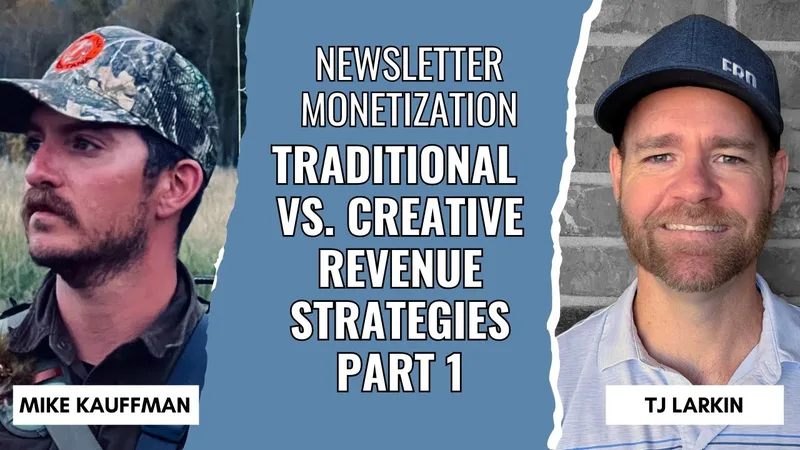
- Creative beats traditional. Michael says you can outperform ad revenue when you get creative. His Catskill Crew started with events, then grew into something locals and weekenders want to stick around for.
- Say no to protect the experience. He will pass on a $10,000 deal if it disrupts his readers, and he says he wants to die owning Catskill Crew.
- Design is easy to win. Changing the inbox background from white to gray makes you pop. Canva alone, he says, puts you ahead of most newsletters.
- Events and community sell ads. His first event beat a full month of ad money in two hours, and the venue did about $7,000 over the bar.
Michael Kauffman runs Catskill Crew, a local newsletter in the Catskills of New York, and he leads The Newsletter Club, the community many of us in local media hang out in. We talked about why he thinks creative monetization beats ads, why his newsletter looks nothing like anyone else's, and why he says no to money that would hurt the reader experience.
Burnout led him to something that was actually his
Michael's background is a mix of startups. About two years before we recorded, he was completely burnt out after too many headwinds raising capital for a bigger venture. He wanted to build something that was authentically him and connected him to his community, and then wear his entrepreneurial hat on top of it.
He started with events. Then he noticed where he lives is a particular kind of place: in the middle of the woods, but close to Manhattan, so he has locals, weekenders and vacationers. He wanted more than events. His goal was a magnet, something that makes people stick around once they find Catskill Crew.
His rule of thumb for local newsletters is that you can outperform ad revenue when you get creative.
The longest game possible
Michael says he is good vibes only: fun and community oriented. If something does not fit that, he does not touch it. That includes a $10,000 deal that he thought would disrupt his readers.
What am I gonna sell it for? What am I gonna go do with that money? I just want to run Catskill Crew, so I'd literally be selling my future.
He joked that a $2 million acquisition offer gets a no, and $2.5 million gets a couple of beers. Then he got serious: he is playing the longest game possible and wants to die owning the newsletter. He also does not treat subscribers as content consumers. They vote on what goes in. He had just launched a houses section for the first time, and his community picked it.
Design: the inbox is a sea of noise
Michael's first design tip is almost embarrassingly easy. The inbox is a sea of noise, so he changed his background from white to gray. People scrolling and deleting see Catskill Crew and know instantly where they are.
His first newsletter, built on MailerLite, looked terrible, he says. It did not matter. He tells operators not to let the pursuit of perfection become a headwind. He has just been through another major redesign and expects more.
For images he uses Midjourney, and he also goes to the public library, pulls old books with woodcut engravings, and photographs them. Those get layered in because they are part of the Catskills: the history of the 1700s, 1800s and the 1600s, when the Dutch came up here. He wants to take the past and layer it into the present.
His own brand will not travel. If you put woodcut engravings on a Manhattan newsletter, he says, it feels weird. Copying his font does not bother him, but the point is to understand who you are, your market and your content, and build something cohesive around that.
The bulletin: ads that feel like a community board
Michael has been saying no to ads for a long time. He passed up 12 inbounds in a stretch. Early on, a realtor friend sent a big tan headshot in a pink shirt, and Michael knew it was killing his vibe. If you want to disrupt his flow, he says, you better give him a couple of grand, and even then he is hesitant.
So he built a bulletin that weaves advertisers into the newsletter. It runs on the web version as a bulletin board with about six spots of different sizes. His ideal week has several advertisers on it, so you see a hiring post, a house for rent, or a contractor taking on new jobs. I called it a better, non-branded version of classifieds, and he said that was spot on.
His reason: a big line break and a sponsored blurb reads like someone telling you why their business is great. A bulletin makes advertisers feel like crew members in the same town square. He charges more to some, like an HVAC company, than to a small local business running a lean operation that he hooked up.
- 01Weave them in
Make advertisers part of the experience, not a break in it
- 02Price for the right to say no
If you disrupt the flow, it costs a couple of grand
- 03Build long-term relationships
He would rather support good local businesses than max out revenue
- 04Own the upside
He wants to own the businesses he advertises in time
Canva is enough
Michael uses Midjourney and Canva together on the bulletin. The deer and the fly are Canva, the nail is Canva, and an old engraving of a fisher cat came from a library book. I pointed out that even if you only use Canva, you are ahead of 95% of the competition. He agreed, and added that you do not need Canva at all to start: just change the background color in Beehiiv.
AI and the vibe
Michael says anyone can start anything in an afternoon now, and that is a net positive. But plenty of people join and never post, or quit after a week or a month with no money. You still have to show up.
He has zero worries about AI because what he makes is extremely on brand for him. He is not upcycling news. Someone could aggregate events, he says, but people show up for the vibe and for the fact that he brings the community together in person.
Why he would rather make zero dollars
Michael says if he wanted to maximize ad revenue, he would launch on Thursday, Wednesday and Saturday and sign only high lifetime value businesses. But more touchpoints would hurt quality. He ships once a week.
He guessed ads might be around $100,000 a year, and said it is not important. He would rather make zero dollars and support good businesses. He wants to own those businesses in time and use the newsletter as a validation engine and distribution vehicle for new products.
He also barely posts on social for the same reason: he turned down tens of thousands of dollars from businesses that wanted him to post reels, and leans into his strengths.
Competition makes the pie bigger
In a couple of weeks, 14 new local newsletters started in the Catskills. Michael reached out to a ton of them. Some cover corners he cannot, like deep journalism or a newsletter for the queer community, which launched two weeks after he noticed a ski weekend with 150 events he could not cover alone.
His view is that competitors help educate the market. Local businesses have burned money on Instagram and Facebook ads, and a brewery owner told him he used to post for free, then had to pay for that traffic, and now cannot pay for what he once got for free. The real competition, we agreed, is print and traditional media, or just business owners not understanding the model.
The event that beat a month of ads
The best place to find advertisers is your own subscriber list. Michael threw his first event about a year before. He says it outperformed his ad money for an entire month in two hours. The venue did about $7,000 over the bar and moved 12 hotel rooms on a Tuesday. Attendees included local business owners asking if they could do one at their place.
That is his edge: everywhere he goes, he is talking to a subscriber, an advertiser or a partner. Few people know his face, he says, but they know the hat.
Questions people ask
Who is Michael Kauffman?
How does Catskill Crew make money?
Why does he turn down big ad deals?
Does competition in local newsletters hurt?
TJ is the founder of Local Media HQ. Every week he talks with local media operators about what is actually working in their towns.