
Why local newsletters are the easiest media business to understand
Francis Zierer of Creator Spotlight on why local newsletters are such clear businesses, why Marissa Lovell doubled her revenue by hiring sales, and why trust is his bet.
 TJ LarkinHost, Local Media HQ PodcastApril 29, 2026 · 10 min read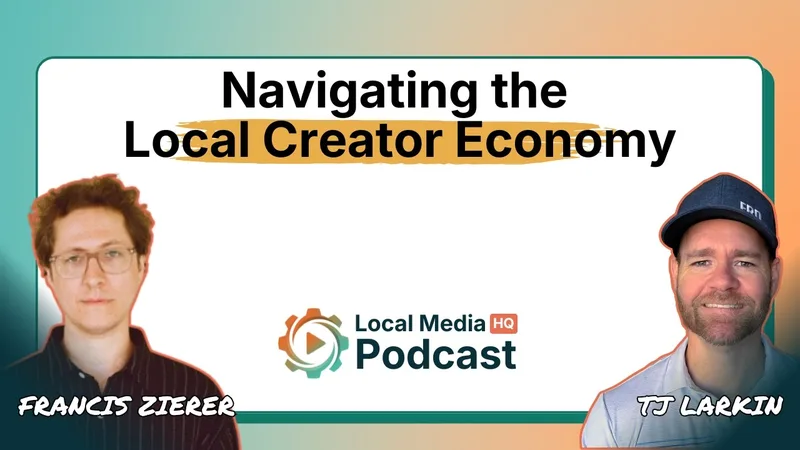
- Local is easy to understand. The total market is the population of your city, so the problem and the fix are clear, and local advertisers can see who they are buying.
- Know what you are bad at. Marissa Lovell was close to quitting, hired a salesperson, and by Francis's memory went from about $30,000 in the first half of the year to about $100,000 by year end.
- Use the brand you work for to build your own. Francis runs Creator Spotlight for Beehiiv and is clear he would be leaving something on the table if he did not build his own name too.
- People business beats systems business for most of us. His line: every business is a hospitality business. The solo creator is mostly a myth, so find a partner whose strengths cover your weak spots.
Francis Zierer is the editor of Creator Spotlight, which Beehiiv owns. He is not a local media operator, but he has interviewed several of them, and their episodes are among his most popular. So I asked him what he sees from the outside. His answer: local newsletters are one of the clearest businesses in media, and the people running them tend to be good people who are hard to fake.
A newsletter built to look serious
Francis was hired about two and a half years before we recorded. The final step of his interview was to write an issue of the newsletter as if he already had the job. He put his whole vision into it and got hired.
His first day was January 2, 2024. He wanted the design to feel like a newspaper, which is why the background is beige. His reason: guests should walk into the brand and get an "aura of seriousness" from how it looks. He worked with Beehiiv's in-house designer on it.
Video came later. The team reinvested their producer's time into slick intro clips instead of cutting clips of episodes, and the YouTube channel crossed 5,000 subscribers in April. A year earlier it had just over 1,000. Shortly after launch it was at 16.
Learn from the industry next door
Creator Spotlight guests include newsletter writers, YouTubers and podcasters, and Francis does not mind that people wonder how they connect. His view: it is better to borrow from something adjacent to you than from your direct competitor, because then you are just copying them.
I know that from insurance. People in that business only watched insurance content, when the real job was sales and the best sales ideas lived outside insurance. Francis sees the same thing when a local operator hears how a B2B newsletter works and asks what happens if they try it in their town.
Why local newsletters are so easy to understand
When Francis looks at the local operators he has interviewed, the word he keeps coming back to is legible. It is a clearly defined problem with a clearly defined solution. In startup land, the total addressable market is a fantasy you sell to yourself and investors. In local newsletters it is small and real: the population of the city you live in, and the demographics inside it.
That makes it easy to reach, with content and with Meta ads. It also makes it easy to package for advertisers. You can say who you are after, run a welcome survey, and show a local business exactly who is on the list.
Francis also noticed what these newsletters leave out. It is rarely journalism. Often it is no politics and no crime, because that alienates readers and does not help the business. He compares it to the classified section of a newspaper rebuilt as a newsletter, a curated point of view on local events in a world where Facebook Marketplace is full of slop.
His last point was about the people. They tend to be from the community or deeply involved in it, and they care about it. Francis thinks the model filters out bad actors, because you have to be someone people like and want to work with.
Marissa Lovell and the myth of the solo creator
Francis's example is Marissa Lovell of From Boise. She had been at it about four years and was close to quitting. As he remembers it, she made about $30,000 in the first half of last year, then hired a salesperson and finished around $100,000. The second half more than doubled the revenue, because she accepted she was not good at sales and brought someone in who was. He told listeners to check her Creator Spotlight interview for the exact numbers.
He contrasts her with Michael Kauffman of Newsletter Club, who comes from the startup world and is good at building systems. Francis calls that a unicorn. The solo creator myth is one he kind of hates. Most people do better with a partner, even if that means cutting someone in on profits.
You'll be better served by working with a partner whose strengths match your weaknesses.
I pushed back with the hard part. If you are not making money yet, how do you find someone as invested as you are? I have tried a few people on commission, and they left when something looked greener. Francis agreed it is hard to ask someone to buy into a thing built in your image. His thought was that it may be easier to start something with a partner from the beginning, even though that complicates things. I am still looking.
Your name and the brand you work for
Francis knew from the start that it would be Creator Spotlight, not the Francis Zierer Show. He also knew he would get the benefits of being the face of it, with the security of working for a company. A brand name that is not you is safer. If he got sick for a month, his assistant editor could carry on. Putting yourself out front builds a closer relationship with the audience.
He believes people at traditional media companies should be building their own brand too, as job security if they are laid off or want to go out on their own. He swore in college he would never make a LinkedIn account, then made one in 2018, two years after graduating. Now he is on it every day.
Big companies are in a different spot. A 6AM City writer in one city who builds a personal following has every reason to leave, so Francis expects the larger companies not to hand that power over. The independent creator has the direct connection with the audience. Francis added that he likes being part of a company and its resources.
Every business is a hospitality business
I asked whether the creator route or an AI systems play is the smarter bet. Francis said that if you are great at systems, build the systems. For most people he thinks the answer is relationships. His line: every business is a hospitality business. You owe your clients, customers and audience that duty, and people want to buy from and read people they like.
He has noticed that many successful creators with money-making systems come from investment banking or consulting. Francis said plainly he is not that guy. If you can look someone in the eye, shake their hand and joke with them, he thinks the creator model fits you better. I added that this is even more true locally.
The medium mullet is just content marketing
I asked Francis about the medium mullet, where media is the front and another business is in the back. His answer: it is content marketing, where the content is a loss leader for something else.
Two examples from his interviews:
- Natalie Peters. She runs Sky Society, an accelerator for early-career women getting into marketing. It costs about $7,400 for eight weeks. Her newsletter, podcast, TikToks and email-gated job boards all feed it. The interview was not out yet when we recorded.
- Matt McGarry. At the time of Francis's interview, a year and a half earlier, he had a free newsletter, a cohort-based newsletter growth course for about $800 a month by Francis's memory, and an agency. The same ideas at three price points, for people with different amounts of time and money.
Creator Spotlight itself is one, Francis said. It sells ads, and it also drives leads to Beehiiv. I floated a real estate newsletter or a politician as local versions, and he agreed the idea carries over.
Becoming the minor deity of your town
Francis spoke to a few people who run communities, and he uses the phrase major and minor deities. These are people others have a one-sided relationship with, who are a reference point and set the tone. In the newsletter world, he calls Michael Kauffman a major deity. Run a healthy local newsletter and you can be one in your town. People know you at the farmers market, and if you are good at the job, you learn their names too.
Many of these operators fill a gap. Maybe no one covers the town anymore, or the paper has been around so long that people are tired of it. Francis added that he has been going to more events lately. If two local newsletters cover the same things and one throws events, he would subscribe to the one he feels a human connection with.
Trust, AI and what lasts
I made the case that AI will flood everything with average content, and that trusted people will be worth more. Francis would not promise media brands keep going up. His point is that they are not going down. Old ones die, new platforms mint new attention millionaires, and there will always be a market for work that is intentional and high quality.
His rule is to make something you want to see in the world, but stay aware that it sits in a marketplace if you want to make money. That is what Marissa had to learn. Her strength was making the thing, and selling ads was someone else's job.
I added that the best way to trust someone is to shake their hand. In local you can go to the event and see if the person is real. Francis noted that Creator Spotlight's best episodes are about independent, bootstrapped media entrepreneurs, because they are easy to root for.
- 01Make what you want to see
Care about the craft and the quality, and want it to exist.
- 02Respect the market
If you want money from it, you have to be sensitive to what buyers need.
- 03Cover your weak spot
Marissa hired a salesperson. Find someone whose strengths match your weaknesses.
- 04Put your name on it
Use the brand you work for to build your own reputation.
- 05Show up
Events and in-person connection make people trust you and like you.
Questions people ask
What is Creator Spotlight?
Why does Francis think local newsletters are such a healthy business?
Did hiring a salesperson really change Marissa Lovell's revenue?
Should I build my own brand or the company's?
TJ is the founder of Local Media HQ. Every week he talks with local media operators about what is actually working in their towns.