
The media mullet: free news up front, big money in back
Nathan May of The Feed Media explains how local newsletters can pair free, ad-supported content with a high-ticket offer, and how to run cheap Meta ads for it.
 TJ LarkinHost, Local Media HQ PodcastSeptember 2, 2025 · 8 min read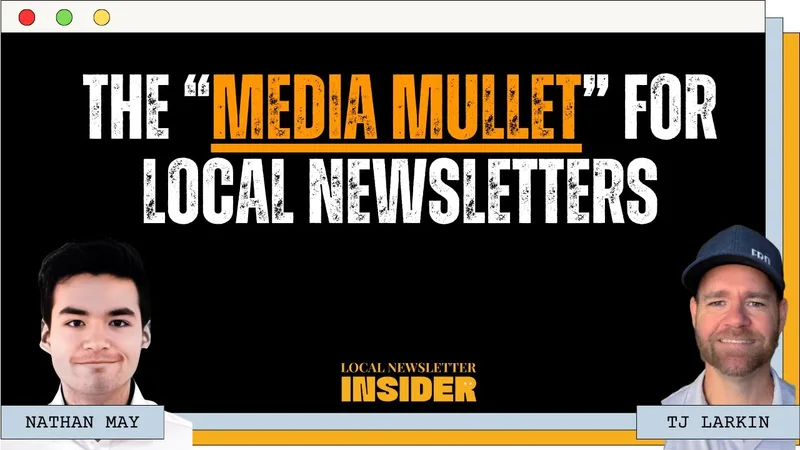
- Sell something in the back. Free, ad-supported content gets readers in the door. A service, event or product worth thousands is where the real money sits.
- Pair local with a niche. Local plus business owners, investors or founders gives you a smaller list with far more valuable readers.
- Name the real problem in your ad. An ad about loneliness in Columbus cut one client's cost per lead in half, and local leads usually come in under a dollar.
- Show up, and sell to high-value businesses. A big chain can't match you at the chamber of commerce, and a med spa or real estate agent can pay back a sponsorship with one customer.
Nathan May spends his days buying Meta ads for some of the biggest newsletters around. In this conversation he explains why the best newsletter businesses aren't ad-only, how a local newsletter can borrow the same idea, and what he has learned about ad creative, big competitors and finding your first sponsors.
Party in the front, business in the back
Nathan's name for the model is the media mullet. The front is free content paid for by ads. It's easy to get people to sign up for something free, and it's much easier than charging a subscription up front.
The back is the part that is yours: a community, an event, a digital product that sells for thousands of dollars, or a service like his agency. He walks through the math. Say you acquire a subscriber for a dollar or two and earn 10 to 20 cents per reader per month from ads. Now add one customer paying $3,000 a month for local SEO. Nathan says that's when it gets interesting. He points out that he doesn't know the exact local numbers, and that he has seen Naptown Scoop make a lot more than 10 to 20 cents per reader.
Why a newsletter beats a sales call
Nobody enjoys being pitched by an insurance agent or a realtor. A newsletter changes that, because it's much easier to like someone after you've read their writing.
Nathan used it himself. He wanted to reach the people running newsletters that earn $1 million to $10 million a year. He guessed there are only 200 to 300 of them, with maybe two decision makers at each, so about 600 people was the whole target. He DM'd them on LinkedIn and invited them to a private newsletter, which was a much easier yes than a sales call.
Then he gave away information he almost felt he should charge for. About 1% to 2% of readers came back and said they loved it but wanted him to do it for them. That's where the agency work came from.
Tiny Money and "local plus something"
TJ asked about Tiny Money, a newsletter from Ted Williams that mixes local with professionals and business owners. On air, TJ said Ted had just posted a 70% open rate, a 20% plus click rate and 10,000 subscribers. Nathan called Ted very smart and said he had heard Axios bought Ted's earlier local newsletter, though he wasn't sure of the details.
His take was to pick a niche and add something else to local: business owners, real estate investors, anything B2B you can sell to. He gave two examples. Justin Gordon runs Just Go Grind LA, a newsletter for LA founders that was a couple of months old and already doing events with sponsors paying real money. In New York, a guy named Andrew runs a local newsletter with a conference of about 1,000 people, and Nathan sat in on a dinner sponsored for $2,000 where six sponsors each got to speak.
Nathan also ran a Columbus real estate newsletter called Duplex. It spoke to people who wanted to invest in Ohio, and a $20 to $30 low-ticket product helped pay for ads. His point: the narrower you talk, the easier everything sells.
What local leads cost on Meta
Nathan asked TJ what local cost per lead looks like. TJ said one client spent $300 a day in one city and stayed under a dollar. After scaling back, they landed under 50 cents. In California, at $20 to $25 a day, they were getting leads for about 15 cents. Nathan's own range for local is typically under a dollar.
He says Meta has been the most efficient growth channel his agency has found, even for B2B audiences. There are two ways to steer who signs up:
- 01Say who it's for
Put the audience in the copy, like "local business owners in Charlotte."
- 02Qualify after signup
Add a short form with a question like "Are you a doctor, physician or dentist?" Tell Meta you got a lead only when the answer fits.
The second one trains Meta to find more of the people you actually want.
The loneliness ad
Nathan's best creative idea came from reading the Columbus subreddit. Plenty of people there said they were 25 or 30, had just moved and didn't know how to meet anyone. Most local newsletter ads promise the top restaurants or parks. For a client at 6AM City, they spoke straight to the loneliness and promised events and activities where you could meet people. It cut the cost per lead in half.
His advice: sort your local subreddit by top threads. People are telling you what they care about, so use those words in your ads.
Will Meta write the ads for you?
TJ asked about Mark Zuckerberg's claim that ads will be automated. Nathan's view is that targeting is already mostly done by the creative itself. Meta shows an ad to a small group, sees who reacts, then builds an audience around it. Fully automated creative is probably a couple of years away, he said, and he compared it to self-driving cars, which stalled on messy edge cases.
Strategy still matters. One fitness newsletter he works with had a sponsored Eight Sleep link that drew about 5,000 clicks. The team realized readers cared a lot about sleep, so they built ads around sleep helping muscle, weight loss and longevity.
Why 6AM City shouldn't scare you
TJ asked what a one-town operator should think when 6AM City is in the same market. Nathan said execution wins. He seeks out competition because it shows people spend money in that area. Industry Dive went from zero to about $110 million in revenue in eight or nine years and sold for $525 million, even in markets that already had newsletters.
You will pay for subscribers with your time or your money.
For a company like 6AM City, he said, a market gets maybe 10% of the focus. You can give yours 50%, travel to meet sponsors and be happy with $100,000 to $150,000 a year. He says 6AM City adds a full-time salesperson once a market reaches roughly $60,000 to $80,000 in revenue, while you keep 100% of every sale. One client got Shopify as a sponsor by walking around a big e-commerce conference and meeting the decision makers.
Using AI without becoming slop
Nathan thinks a curation newsletter should be using AI in some way. He described one operator who pipes saved stories through an automation tool, reads AI summaries and swipes left or right on each story before publishing. He called it good, though not as good as The Rundown or The Neuron.
For local, he thinks event roundups are the easy thing for AI to copy. What it can't copy is you at the chamber, your face, and short video at local restaurants and fairs. His own habit is to let Claude write a first draft, then edit it, since he's a better editor than first drafter.
Selling your first sponsors
The first move is Instagram DMs to business owners and showing up in person. Aim at businesses where one customer is worth thousands: real estate, insurance, med spas, dental implants. Restaurants are what everybody wants to read about, he said, but they don't make enough per customer to be good advertisers.
Keep the field small. Could you meet 50 real estate agents and get one to sponsor? Nathan thinks so. He's also building packages: a main ad, a second ad, a quarterly Instagram video, a top spot on the website for two weeks and a directory listing, sold at one price.
Starting a B2B newsletter
Nathan thinks B2B is easier than B2C for most people. Lists are small but valuable, and you can sell ads or services for a lot. B2C works if you already have a big audience, he said, like an Instagram fitness account with 200,000 followers.
Then niche down once or twice. Aging Media, for owners of senior care facilities, reached $10 million in revenue. The Ankler's Real AI covers AI inside Hollywood. Nathan's advice is to combine two things you know.
Questions people ask
What is the media mullet?
How do you keep local ads from reaching the wrong people?
Where do good local ad ideas come from?
Which businesses should local newsletters pitch first?
TJ is the founder of Local Media HQ. Every week he talks with local media operators about what is actually working in their towns.