
Buying and rebuilding a legacy local media brand
Keith Pepper bought five monthly print papers in 2020 and made them digital first. Print is still over 70% of his revenue. Here is how the mix works.
 TJ LarkinHost, Local Media HQ PodcastJanuary 28, 2026 · 10 min read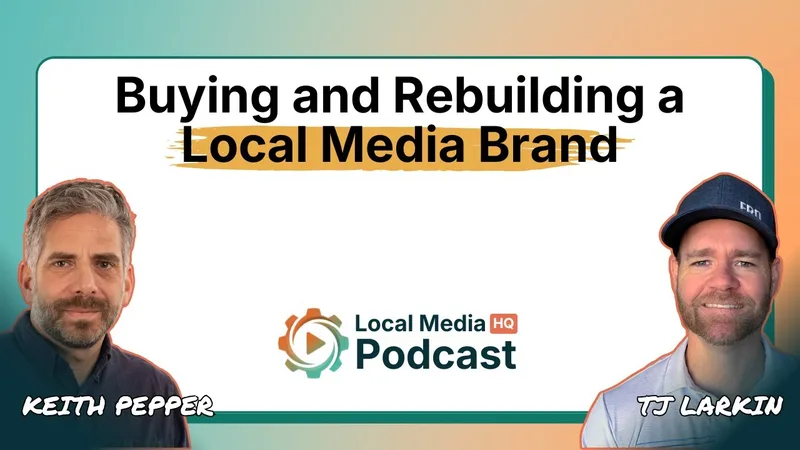
- He bought a print company at the height of the pandemic. Keith Pepper took over five monthly papers in 2020, with about 99% of revenue from print ads, and flipped the company to digital first without giving up print.
- Print pays because of how it is delivered. Rough Draft buys saturation mail routes and sends the paper to every home on them, so advertisers get a chosen, affluent audience and almost no print competition.
- A newsletter is the new morning paper. A general interest newsletter goes out at 7 a.m., Monday through Saturday, and weekly vertical newsletters follow in the afternoon, all on one ad format.
- Sales has to be someone's full-time job. The team leads with full-page annual ads for high-ticket businesses, sells only direct, and skips programmatic ads and house ads.
Keith Pepper owns Rough Draft Atlanta. He bought it in 2020, just after the pandemic hit, and he calls himself an accidental entrepreneur. Five years later it is a digital-first company that still earns most of its money from print. In this conversation he explains why saturation mail works, how the newsletters fit around it, and how his team sells ads without leaning on small shops.
Starting with five monthly papers and one revenue stream
The company Keith bought had five monthly print publications. About 99% of its revenue came from print advertising, and it was print first in how it distributed and how it talked to readers. That was true of the revenue and of the whole operation.
Over five years he flipped that. Everything now goes on the website first, then to social, then out through newsletters. The company is digital first in how it works, even though it is still print first in how it earns.
Print revenue has stayed roughly flat. Some years it went up and some years it slipped, and Keith says the most recent year was his biggest print year since he took over. The real growth came from digital display ads, sponsored content and newsletters, which he describes as hockey stick growth. Print is still a bit over 70% of revenue. A reader membership program makes up a little over 1%.
Why monthly print works when daily print does not
Keith is clear that the future is digital, and that daily print has no future. He points out that Atlanta's major daily no longer prints. A weekly, fortnightly or monthly print product is a different story, and the difference is distribution.
His papers are mailed. He buys mailing routes and sends the paper to every home on them, whether people asked for it or not. That makes it feel more like a magazine, and for advertisers it behaves like a direct mail product. The model where readers pick a paper up at a coffee shop or a dry cleaner is the part he sees shrinking.
We purchase mailing routes and deliver the paper whether you want it or not into homes in those routes. So we're able to choose our audience.
He started in very affluent, very engaged Atlanta communities, so advertisers get a coveted audience. He is a fan of digital ads and says his own digital ad revenue is growing every year, but he thinks people engage with a print product differently.
He compares it to vinyl. He has a turntable and a record collection, but he streams his daily music. Now and then he wants the lean-back experience. Print can serve that moment for readers, as long as it lands in the mailbox.
Over half the pages in his papers are ads, and he aims for 60%. He says that is fine, because readers already saw the stories on the website or in a newsletter, and the paper gives them another chance to lean back and read.
One format, one brand and a copy of the Community Impact playbook
TJ brought up Community Impact, the Texas publisher. Keith agreed the models are identical, "just everything is bigger in Texas," and said he is still learning from how that company scaled while controlling the variables.
For Rough Draft that means every paper in every market looks the same, with the same format and the same ad sizes. There is also one digital presence, one Rough Draft brand for the metro, instead of a separate site per paper.
The newsletter is the morning paper
The morning newsletter goes out at 7 a.m., Monday through Saturday. It is general interest, with a little local, national and international news, and Keith describes it as what you need to know if you have three or four minutes to start your day. He says the model traces back to the Charlotte Agenda, Morning Brew and Daily Candy, and everyone is iterating on it.
The afternoons are for vertical newsletters, mostly weekly. There is one for seniors on Tuesday, then art, LGBTQ, the Jewish community, film, and dining twice a week. There are also weekly neighborhood newsletters that match the print territories. All of them share one format and the same ad sizes, so the team does not rebuild anything each week.
Keith could make this easier with a more automated, RSS or AI-driven product. He says it is worth it to curate by hand, and preparing tomorrow's newsletter is the team's main job each day. One of his first jobs was producing a morning radio show, so he thinks of it as a morning show for your inbox.
The vertical newsletters grow mostly through cross promotion: the morning newsletter, the website, social and a little ad spend. He said they are toying with Meta ads. One story can run in the art newsletter, the morning newsletter and print.
How the sales team works
The first thing Keith says about ad sales is that it has to be someone's job, every day. His team has deep print sales backgrounds, and he says the discipline of structure, reporting and metrics is the only way it works. Once a company reaches a certain size, he thinks the highest paid person should be a salesperson.
The goal is full-page ads on annual contracts. They bring the most money per client, and they are the easiest to produce, because those advertisers usually have their own designer and send camera-ready art.
Keith is upfront that Rough Draft has no great answer for small businesses. His team goes after businesses with low transaction volume and high transaction value.
- 01Real estate brokers and agents
One client from an ad a year can pay off the spend
- 02Specialty medical practices
Few deals, large ones
- 03Financial services
Print works for top-of-funnel awareness
- 04Legal firms
Same logic: big tickets, few clients
Bars and restaurants used to fill papers like his, but he says they have moved to social, Google and Facebook. It took him a while to realize it, and longer to get the team to agree, but his line is that he would rather have a small slice of a massive ad budget than all of someone's tiny one.
No programmatic ads and almost no house ads
Keith sells direct only. His site has no programmatic ads, because he thinks they make a bad user experience and Rough Draft does not have the scale to make real money from them. In a newsletter he says it would be pennies, and you do not control who sits next to your direct advertisers.
He also runs few house ads. With unsold inventory he would rather bonus a good advertiser or give the space to a nonprofit, and the company allocates 10% of its revenue to sponsor local nonprofits. His reasoning is supply and demand: a newsletter should look like a place other advertisers want to be in.
TJ asked what to do with a 10,000 subscriber newsletter and no budget for a salesperson. Keith said to approach community leaders, such as community foundations and civic groups, and give away a couple of ads to get good brands in. Then other advertisers see who is already there.
Sponsored content, display ads and newsletter ads
Digital advertising at Rough Draft is three products, sold at a flat monthly fee rather than by CPM:
- Display ads. Four sizes, on mobile and desktop, and only bought directly from the company.
- Sponsored content. A labeled narrative article on the site. Sometimes the team writes it or hires a freelancer, and sometimes the client or an agency does.
- Newsletter ads. A 40-word text ad, or a sponsored post that excerpts the story, around 90 words at most, with a gray box around it.
He calls sponsored content another product on the menu. It never comes down unless a client asks, it performs well in search, and it goes out to syndication platforms such as Google News. Keith has not had a client ask for one to be removed.
He is skeptical of backlink deals, which he calls transactional and not something to build a business on. He suggests selling sponsored content to local companies instead, and points to Canada's Village Media network as an example.
Growing slowly and staying close to home
Keith grows in two ways: new geographic markets next to existing ones, and new subject areas. In five years the company has expanded into one new market, and a second launches the month after the interview. He wants to stay within 10 or 15 minutes of his current communities, so he can be at a city council meeting or in front of a local business quickly.
On the subject side, he hired the former editor of Eater Atlanta to build up food coverage, and added art and film. A sports newsletter did not take off, so the team scaled it back.
It is all bootstrapped by Keith. No big company owns it, he says, and he funds growth from existing revenue, with a view to profit coming quickly.
At the end of 2024 Rough Draft bought the regional LGBTQ paper, the Georgia Voice. It was not in growth mode and wanted a buyer. Keith already had a large audience in that community, and he could move the paper onto his web platform and print process, which took a lot of cost out of it.
Asked whether other people should buy a legacy brand, he said yes, because he is having a great time. But it depends on whether you want a lifestyle business or something to flip. Keith points to big sale prices elsewhere, but those companies have global audiences, and he says scaling locally is significantly harder.
Questions people ask
Why does print still bring in over 70% of Rough Draft's revenue?
What is in Keith's morning newsletter?
Who does Keith sell ads to?
What does he do with unsold ad space?
TJ is the founder of Local Media HQ. Every week he talks with local media operators about what is actually working in their towns.