
A Paid Happy Hour, Rivian Calling and Cold Email for Sponsors
John Apolinar of Scottsdale Scoop on his first paid happy hour at the W, why Rivian wants to pay him to host, and the $4 mailboxes he uses to cold email sponsors.
 TJ LarkinHost, Local Media HQ PodcastSeptember 16, 2025 · 9 min read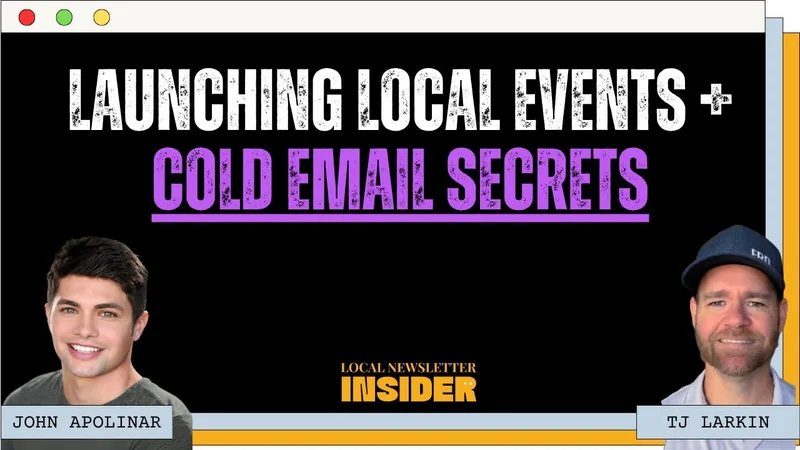
- Keep the first event simple. A happy hour at the W in Old Town Scottsdale, an injury attorney covering the venue and drinks, and a paid ticket. John had 37 people registered and just over $500 in ticket sales a week out.
- One event pulls in the next ones. Rivian offered to pay him to host at their Scottsdale office, and a wealth management firm liked his idea for a Shark Tank style night with local investors.
- Cold email can be cheap. Three domains at $15 a year, six mailboxes at about $4 a month each, and 10 to 15 emails per inbox per day. Three sponsors closed in one week, all small one-offs.
- The welcome flow is the next thing to monetize. Every new subscriber answers a survey, and John wants to turn those answers into sponsor offers or paid leads the moment someone signs up.
John Apolinar runs Scottsdale Scoop, and when we recorded he was a week away from his first paid event. We talked about how he set it up, who is already asking to host the next one, the cold email setup he is using to close sponsors, what is working on Instagram, and a monetization idea for the moment a new subscriber signs up.
A happy hour that is paid but easy
John thinks events matter for any local media company, because they put a face and a personality behind a digital newsletter. He kept the first one simple on purpose. It is a happy hour at the W in Old Town Scottsdale, and people buy a ticket on a landing page. The pitch is a chance to meet neighbors who care about what is happening in Scottsdale, with a free drink included.
An injury attorney came on as the sponsor. John first pitched them $1,200, but the person he was working with said she could not take a budget like that to her boss for an event they had never done. She could cover the venue cost, and John took it. The W gave him the space at a big discount. They did not charge for the room, just a drink minimum, and the sponsor's money covers that.
He had 37 people registered and a little over $500 in ticket sales, with another newsletter mention going out the next day. The sponsor is also giving away raffle prizes, including tickets to sporting events and restaurant gift cards, and John plans a small donation drive for a local nonprofit at the back of the room.
It's just a happy hour. I kept it really, really simple, just like, "Hey, come out, grab a drink with some raffle prizes that the sponsor is giving up."
Rivian wants to pay him to host
The interest started before the first event even happened. It comes through the sponsorship form on the newsletter, where businesses write in. Rivian reached out to say they have a big office in Scottsdale, saw the event, and would pay John to host one at their place. He was meeting with them that week.
TJ pointed out why this is a good sign. Plenty of venues in Scottsdale will not hold a spot for you, but some companies have space and want people in the door, so they will pay to have your crowd.
A Shark Tank style night for investors
John is already talking to a wealth management company about a bigger second event. His idea is local investors on a panel, local businesses pitching for funding, held at a private estate in Paradise Valley. He floated it on a call, they said they would love it, and he had a meeting with them that Friday.
He also wants those sponsors to buy at least two newsletter ads before he will run an event for them, all bundled into one price. That gives the sponsor two digital touches and one in person. He has also been meeting with small breweries that would let him use their space for free.
TJ added two examples. A company in Austin called Astronomic borrows empty mansions and brings in investors to hear startup pitches, and a New York newsletter founder grew his list by hosting events before he ran ads. John's take is that a local, simpler version could work for any business owner.
What cold email costs and what it brought in
John is closing sponsors with cold email, and he has a background in it. He closed three people last week, all smaller one-off sponsorships, which he says is the downside of cold email because you are making the case to someone who did not ask.
His setup is a tool called SmartLead. He buys separate domains for sending so his newsletter domain never takes the spam complaints. He has three domains with two mailboxes each, and sends 10 to 15 emails per day from each inbox. He had seven responses in about six weeks, four early on and three in the most recent week. He is not 30% of the way through his list, and says even 10 customers would be a big win. TJ added that it would be a good deal even at $300.
John says SmartLead's plan is about $49 a month, and that it handles the domains, the mailboxes and the sending. You still need a list. He recommends paying someone on Fiverr or Upwork about $100 to scrape 1,000 leads in the categories you choose. He uses Clay himself, but says it is complex for what local media needs.
He is not a fan of Instantly. His complaint is that unless you are on the top plan, you cannot reply when someone answers your email. TJ said a demo he got from Instantly quoted around $500 a month.
- 011
Buy three sending domains, about $15 a year each
- 022
Add two mailboxes to each domain, about $4 a month each
- 033
Send 10 to 15 emails per inbox per day
- 044
Pay someone on Fiverr about $100 for 1,000 leads in your chosen categories
- 055
Pick high-ticket service businesses: lawyers, chiropractors, dentists, senior living centers, home builders
- 066
Skip restaurants, bars and clothing companies
Instagram: green screen and carousels
John studies what Jacob is doing on Instagram and tries it on his own page. His best video format is a green screen: three images in the background and about 10 seconds on each, around 30 seconds total. The topics that work are new restaurants coming in and what is going to replace a place that closes. His most viral posts, though, have been carousels.
His first one to go big was a carousel about a Blue Zone certified grocery store coming to the area. He did not even have photos from inside, just outside pictures from Google. That one post brought in 1,500 followers over a few days. He aims to post once a day and gets at least five posts out a week.
Sponsors usually ask about Instagram, but John has been steering them away from it for now. He does not feel his sponsored posts are entertaining enough yet and does not want to burn their money.
The $400 a month intern
John found a college intern on Handshake and set it to ASU only. He got about five applications. She found his Instagram and sent him a DM, a few people did, and she came across as the most creative one.
She makes three to four carousels a week for $400 a month. One is the events list from the newsletter, five or six events per carousel. Another is the date spot of the week. A third is what is opening in Scottsdale that month, and John says those do well every time. John does the video himself.
The welcome survey and the moment of signup
Every new subscriber sees a survey asking for age, location, income and interests, and then gets a welcome email. John says the data helps him sell sponsorships, but he has not found a way to monetize the welcome flow. He would like to, whether as paid leads or a $2,000 to $3,000 a month sponsorship.
TJ described what he has heard about a form tool called Uform. It can send people to a different page based on their answers, so a homeowner who earns over $100K could land on an insurance partner's page. John liked the idea, and said Tyler from Beehiiv had mentioned a new automation system coming soon, though nobody knew exactly what it would do.
TJ's argument for doing this at signup is the take rate. Asking people to take a survey in an email gets about 2%. Sending people to it right after they subscribe gets 50% or higher, and 75% on one of his newsletters. John noted that if you can earn money on each subscriber, buying subscribers at 30 to 50 cents starts to look very different.
Why John is not building a side business yet
TJ asked whether John would build a second business off the newsletter, like Jazz's Christmas lights company. John says Christmas lights would not work in Scottsdale because big players are already there. His plan is to build the audience first and maybe launch an agency or a home service company later. He would rather wait until he has something like 30,000 subscribers.
Questions people ask
What was John's first event?
How is John finding sponsors with cold email?
What does his Instagram intern do?
What does John want to do with the welcome survey?
TJ is the founder of Local Media HQ. Every week he talks with local media operators about what is actually working in their towns.