
How Nate Spangle Built Get Indiana Into a Half-Million-Dollar Media Company
Nate Spangle turned a podcast nobody heard into Get Indiana, a statewide media company closing in on $500,000 in revenue. He sells to the insurers and banks that can't get a like on their own posts.
 TJ LarkinHost, Local Media HQ PodcastNovember 24, 2025 · 10 min read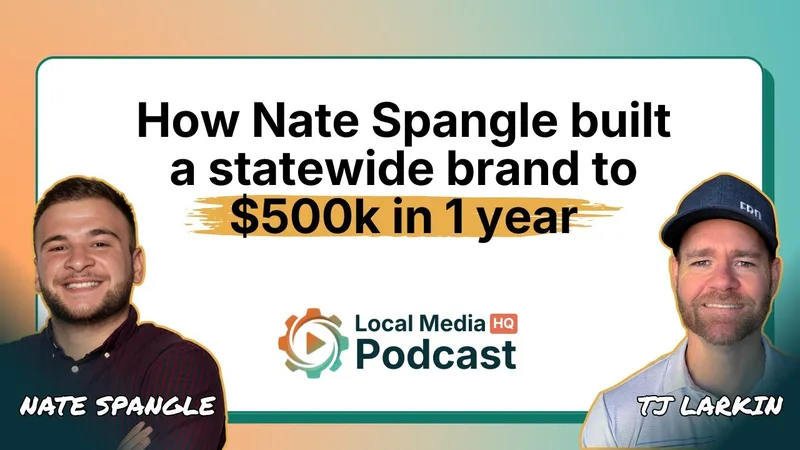
- Hoosier pride rescued a podcast nobody heard. Nate's tech podcast had no listeners and a sponsor ready to leave. Posting "Hoosiers doing inspiring things" instead is what finally got people watching.
- A $3,000 truck turned it into a business. His all-Indiana Indy 500 tailgate brought almost a million views, 15,000 new followers and $10,000 in sponsorship. In June 2024 he left his job and took the podcast with him.
- Sell to the biggest budgets with the smallest engagement. Insurers, banks and healthcare brands post and get a handful of likes. Nate bundles videos, podcast reads and newsletter spots into year-long deals for them.
- Local people run the local editions. Everyone on the team lives in Indiana. Get Fishers and Get South Bend are the first regional newsletters, with all 92 counties as the long-term goal.
Nate Spangle runs Get Indiana, a media company in Indianapolis that is closing in on half a million dollars in revenue this year. He got there in about 18 months of doing it on his own. It started as a podcast that nobody listened to.
In this conversation he walks through the $3,000 truck that changed everything, why he sells to the least exciting companies in town, and how he's building a network of Indiana newsletters. He also admits what hasn't worked yet, like paid newsletters and a $99 hoodie.
A podcast nobody listened to
Get In began while Nate worked at a tech startup in Indianapolis. The company started a podcast to talk to the Indiana tech community. Nate says no one listened, and their biggest sponsor was on the verge of pulling out. It was his favorite part of the job, and he didn't want to lose it.
So he cut the podcast into social clips. Nobody watched those either. Then he tried general Indiana content: his top three coffee shops, the best bachelor party spots within a five-hour drive of Indianapolis. People started watching, even the ones who told him they disagreed with his picks.
What he noticed was the word Hoosier. Nobody is sure where it came from, he says, but being a Hoosier comes with local pride. He built everything around that, and the podcast now covers athletes, nonprofit leaders and anyone with ties to Indiana who is doing something inspiring. It started in 2023, back when he was a co-host on a tech and entrepreneurship show.
The Indy 500 truck
Nate calls the Indianapolis 500 the largest single-day sporting event in the world, and says about 300,000 people come to Indianapolis and Speedway for it. He wanted to do something big around it.
He posted a video while walking into his day job: he was going to be the first truck in the infield, and he'd throw the world's first all-Indiana tailgate. Burgers, beer and breakfast would all come from Indiana. He didn't own a truck, so he spent $3,000 on a beater from Facebook Marketplace, a 1986 Dodge pickup.
At the time he had about 7,000 followers, not enough for anyone to buy a sponsorship. Over six weeks he got almost a million views and gained 15,000 followers, all in Indiana. He made $10,000 in sponsorship along the way, from places like a meat market and a local brewery that wanted videos about them.
After the race he walked into work, said he was going to pursue this media thing, and asked to take the podcast with him. That was June 2024.
From personal brand to a company
In the first months he traded videos for money and did some freelance marketing so he wouldn't lose his house. The plan was to get to all sponsorship as fast as possible, through year-long partnerships. A brand might get six videos over a year and pay quarterly, which made his income more predictable.
Early on, he says, brands were buying a chunk of him. He ran the Indy 500 campaign, then memorized every high school mascot in Indiana and recited them on a live stream. That got him to $100,000 in annual partnerships in about six or seven months.
Then he started building properties that don't need him. The statewide newsletter launched in October 2024 and now goes out twice a week, with more than 100 editions sent. He doesn't write the newsletters or the blog content anymore. The Get Indiana Instagram account, about 11,000 followers, is run by someone else.
Sell to the biggest budgets with the smallest engagement
When Nate hit 30,000 to 40,000 followers, he went looking for companies with the largest marketing budgets and the fewest likes and views. Think of the big insurance company in your town, with a marketing team of a dozen people whose posts get seven likes.
Indiana Farm Bureau Insurance became his biggest partner. They told him they wanted to give value to Indiana, and he was all things Indiana. They'd publish a blog post on top Christmas tree farms in Indiana, and he'd turn it into a video, post it with them on Instagram, then run it in the newsletter.
The packages work because they're bundled. A partner might get four videos, 12 podcast ad reads and 12 newsletter title spots. Nate says even a weak video gets 8,000 to 10,000 views, a statewide newsletter spot gets about 7,000 impressions, and a localized one gets around 2,500. If he charged a big company $1,000 for a single piece, he says, it wouldn't be worth their effort. Spread over a year, it is.
His current partners include insurance, banking and accounting, apartments and realtors, a seven-restaurant group, a plumbing company, a handyman service and an apparel brand with big stores off the interstate. Healthcare is a category he's still working out.
How he got in front of Farm Bureau
He was already a customer. His own insurance agent was with Indiana Farm Bureau, and the agent sponsored the truck for about $500. His logo and QR code went on the side, and he got two new deals from it.
Agents have a local budget for little league teams and billboards, Nate says. Once the agent saw results, Nate asked him to introduce him to the bigger marketing team. They made a video about the history of transportation and the Indy 500. It got 10,000 to 12,000 views, when their typical video got 100 to 200.
- 01Start small
A local agent, a $500 sponsorship on the truck.
- 02Prove it
Two new customers came from the QR code.
- 03Ask for the intro
The agent introduced him to the bigger marketing team.
- 04Do one video
It beat their usual views by about 50 times.
- 05Make it annual
A year-long partnership followed.
For the rest, he says, you just need one advertiser to bite and a result that blows them away. When he advertises a plumber, the roofers call. When he signs one bank, the other banks notice. He stays loyal to the first mover, and says turning down a competitor's money makes people want in more.
Hiring people who already do it
Everyone on Nate's team lives in Indiana. He says there are cheaper places to find labor, but he's making Hoosier content with Hoosiers, sponsored by Hoosiers. He also says no to national advertisers who have no tie to Indiana.
His first short-form editor was a student on his wrestling team in high school. Nate stayed in touch, saw that the kid had grown a car TikTok to about 40,000 followers, and offered him a job and access to the studio. He's edited videos that have passed 15 million views. He's about to be a senior at Purdue.
The Fishers writer had started a local podcast with her sister because she loved her town. Nate didn't post a job ad for her either. The way he sees it, you can't pay someone to care about where they live, so you find people who already do.
if you wouldn't do it for free, getting paid is not going to help you. It's not going to make you any better at it.
Buying Fishers Digest
Get South Bend started from scratch. Nate says they put about $1,000 a month into Facebook ads to grow the list. For Fishers, he found a newsletter that already existed. Skyler started Fishers Digest in late 2022 or 2023 and grew it to 5,000 subscribers with a 75% open rate, mostly organically.
Fishers has just under 100,000 people, close enough to Indianapolis that a bigger newsletter would swallow it. Skyler realized it was hard to build a big business on a town that size. Nate's statewide advertisers wanted into that suburb, so the two agreed Get Indiana would acquire it.
Today the newsletter is written by a local mom of three who writes about new restaurants, developments and school board votes. Nate says some of it is AI-assisted for sourcing, but the stories come from someone people see around town. There's no crime or death, just positive stories about what's happening. If it works, he wants to repeat the model across the state.
What hasn't worked
Nate tried a paid newsletter, an event roundup of the whole state, for $3 a month. About seven people signed up. He figures a single ad in a free version could make $500.
Merch has been mixed. His first hat drop sold out in about 25 minutes, but a $99 hoodie did worse. He calls these shiny object syndrome. Right now he'd rather keep advertisers happy through their first renewals, which just came due for year two.
He also hasn't solved how to pay creative talent. He points to Barstool-style talent contracts, with a multi-year deal at a set rate before renegotiation or a bigger company picks the person up. For now he runs open-book financials. His full-time team can see the bank balance and what everyone makes, and raises come with milestones like a first million views.
The goal: all 92 counties
Nate's three-to-five-year goal is to own the state, with more media distribution in Indiana than any other company. He makes an exception for Pat McAfee, whose show is in a different lane. He wants the next Caitlin Clark's PR team to call Get Indiana first.
He also wants someone in all 92 counties, so each one gets content that makes people proud to be from there. He wants to change the idea that Indiana is a flyover state where nothing happens.
His closing advice is to be curious about your place. If you're in the business just to make money, he says, people see through it. His team sits down in the morning, goes down internet rabbit holes about Indiana, and documents what they learn.
Questions people ask
What was Get Indiana before it became a statewide brand?
How did Nate Spangle reach roughly $500k in revenue?
Why do insurance companies and banks work as sponsors?
What is Get Indiana building next?
TJ is the founder of Local Media HQ. Every week he talks with local media operators about what is actually working in their towns.