
Newsletters Are Still Early, and Niche Wins
Dan Oshinsky of Inbox Collective on why it's not too late for newsletters, why going narrower beats chasing scale, and how to sell local ads with a spreadsheet and a lot of follow-up.
 TJ LarkinHost, Local Media HQ PodcastDecember 26, 2025 · 9 min read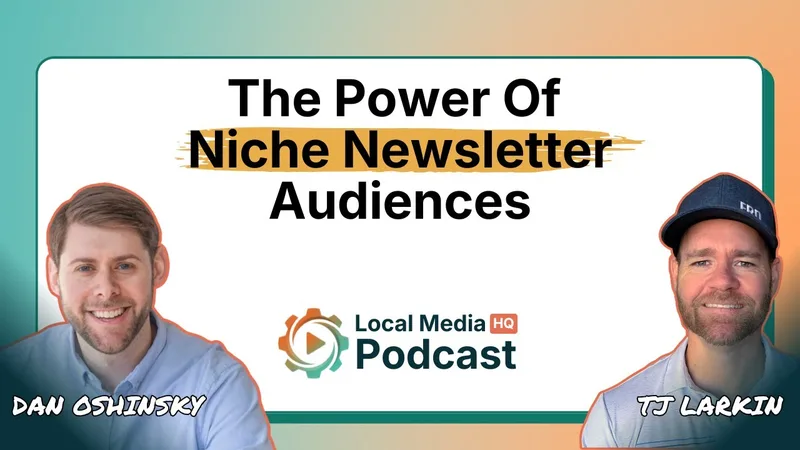
- It's not too late. Dan says we're "still in the very early stages" of newsletters as a line of work, and the tools are far better than they were in 2015.
- Go one level deeper. Morning Brew became The Peak for Canada, then a version for Canadian dentists. Local plus newsletters is a smaller audience, but it is not a saturated one.
- Ad sales is relationships and follow-up. Build a spreadsheet of everyone already advertising, target the places too small for billboards, and don't quit after one unanswered email.
- Build the audience, then decide. Once people trust you, you can add events, memberships, consulting or a second business. Dan says no to more things than he says yes to.
Dan Oshinsky has spent more than a decade inside newsletters. He built BuzzFeed's program, ran strategy at The New Yorker, and now consults for newsrooms, nonprofits and independent writers, including plenty of local operators. In this conversation he explains why newsletters are still early, why the smart move is to go narrower rather than bigger, and how local operators can sell ads when they don't have decades of relationships.
He got into newsletters by accident
Dan started at BuzzFeed in December 2012. Recording was almost exactly 13 years to the day later. He had reached out just to ask what BuzzFeed was doing, and the company told him to come back with an idea. His pitch was email, because it is "really the original source of sharing on the web."
Back then, almost nobody was building for email. Politico's Playbook and The Skim were among the few. Dan says the team found that if you build really good original emails, you can grow an audience, build an audience, and down the road monetize it. In the first two and a half years, with no paid growth, the BuzzFeed list went from zero to more than two million subscribers.
Why it's still early
TJ's point was that outside the newsletter bubble, most people know nothing about any of this. Dan agrees, and adds that the tools have changed. In 2015 or 2016 you would have been on Mailchimp or TinyLetter. Beehiiv, Substack and Ghost weren't around in the same way, and tools like Kit were in their infancy.
His conclusion: it's certainly not too late, because we're still in the very early stages of this line of work. He didn't predict people leaving big outlets like CNN to build a business around a newsletter, and says he couldn't have.
Go one level deeper
Dan's favorite example of niching is a chain. Morning Brew did well. Then The Peak launched in Canada, which he describes as Morning Brew for Canada. Then came a version for Canadian dentists, which was later bought by an industry association. He couldn't remember the name for sure, so we are leaving it out.
He applies the same logic to himself. When he launched his first newsletter about newsletters in January 2019, there weren't any others. Now there are lots. If he were launching today, he would ask how to go more narrow and more niche. The audience for local plus newsletters is smaller than the audience for newsletters, which is smaller than the audience for email marketing. But nobody wants to go up against a brand like HubSpot, and in local there are potentially thousands of operators who are serious about email.
Newsletters plus something you already know
TJ's idea, which Dan builds on, is that your edge is combining newsletter skills with another area you know well. A dentist, an accountant or an insurance adjuster who also understands media may be the only person who knows both.
Dan makes the same point about audience as a megaphone. Politicians now start podcasts so they arrive with an audience when they announce. A local insurance adjuster with a newsletter gets the same thing for their business.
For Dan, the audience came first and the decisions came later. People told him to add a membership or a Slack room, and he said no. He did say yes to events, talks, ebooks, consulting and teaching. His summary: once you've built the audience, you get to decide where you want to go from here.
Why local is open, and why Dan hasn't started one
TJ says the real moat is audience, and that building one locally is easier because few people are doing it well. Dan is a rare exception. In Park City, Utah, he found three good daily newsletters plus one for events, in a town with a year-round population he put at about 10,000. He didn't want to compete or annoy the people running them. He says that anywhere else he would have launched one.
He also shares examples of newsletters with a business attached. Energetic City in Fort St. John, British Columbia, has a newsletter and a marketing business that sells the same results to local businesses. Naptown Scoop in Annapolis, Maryland, is run by someone who also has a portable toilet business, and the newsletter helps promote it.
You don't have to be someone who went to a J school like me to do that job. If you do a good job of covering the community, you're independent, you're fair, anyone can do that sort of thing if you're curious, if you're smart, and if you work hard at it.
Selling ads is a relationship business
TJ asked why legacy local outlets sell six or seven figures of ads while newer operators struggle. Dan's answer: it's just relationships. That's really all it is. Legacy players have decades of trust. Independents have to build it.
- 011. Build a spreadsheet
List everyone you see advertising anywhere: local radio, newspapers, bus stops, billboards. If they advertise, they have a budget.
- 022. List who isn't advertising
Look for places too small for billboards or big newspaper ads: bars, restaurants, yoga studios, theaters, arts venues, dry cleaners.
- 033. Ask what a new customer is worth
A yoga studio 10-pack runs about $250. A loyal dry cleaning customer can be worth hundreds or thousands a year.
- 044. Offer to prove it
Say you'd love to find a way to work together. Maybe you give some ads away or discount heavily at first.
- 055. Show up
Go door to door, shake hands and invite people to coffee. Ask each happy sponsor who else you should talk to.
Dan's example in Park City is a local pie shop owner who also sits on the Chamber of Commerce. Partner with her and drive results, he says, and she opens doors to another ten people. Real estate is another big one, because agents selling multimillion-dollar homes know what a commission is worth.
Follow up more than feels comfortable
Dan says the most common mistake is sending one email to the dry cleaner, hearing nothing and moving on. His collaborators Ian and Nate taught him that it may take multiple points of contact before you set up that meeting. Business owners are busy and not living in their inbox.
His advice: email, wait a couple of days, follow up, show up in person, invite them to coffee. One of his clients, Boulder Reporting Lab, just hired its first salesperson, whose job is to walk the streets and go to Chamber and business association meetings.
If a business says no, ask to add them to your email list anyway. Then follow up occasionally and ask what they think. Dan says people he met two or three years earlier have come back and said now is the right time. TJ added a tip from the other side: unless someone tells you they're not interested, assume they're busy.
The Charlotte Ledger shows where it goes
Dan has worked for five or six years with the Charlotte Ledger. Tony Mecia left the Charlotte Observer, started it on Substack, and it began as basically a one-person newsletter. Today there are multiple newsletters, including one on transit and one on the local MLS team, Charlotte FC. There is also a podcast and a set of events.
The events include an annual "40 over 40" gala, which started as a joke about Forbes' 40 under 40. This past year they hired their first full-time ad salesperson, Ava. She can offer the main newsletter, a secondary newsletter, an event, a webinar or a white paper. As Dan puts it, you have all these different touch points with the community.
His bigger point is that the newsletter is where it starts, not the end. Layer on events, social and different touch points, and customize for specific neighborhoods and communities.
The ad playbook
Dan built, with Ian and Nate, a newsletter ad playbook with step-by-step instructions. It includes a tool that makes a media kit in about 10 minutes, tracking tools for leads, and an email template plus AI prompts for cold outreach. You also submit your media kit and sales details, and the three of them send back what's working and where you're leaving money on the table.
He gives one example of where this can go: Rob, who runs the newsletter Daybreak serves the Upper Valley of New Hampshire and Vermont. Dan met Rob six years ago when it was a side project, and it is now a six-figure revenue stream. Dan's last piece of advice for any newsletter: be willing to change the cadence. He is moving from weekly to twice monthly in 2026 because readers respond to deep dives.
Questions people ask
Who is Dan Oshinsky?
Is it too late to start a newsletter?
How do you start selling newsletter ads locally?
What is the Inbox Collective ad playbook?
TJ is the founder of Local Media HQ. Every week he talks with local media operators about what is actually working in their towns.